
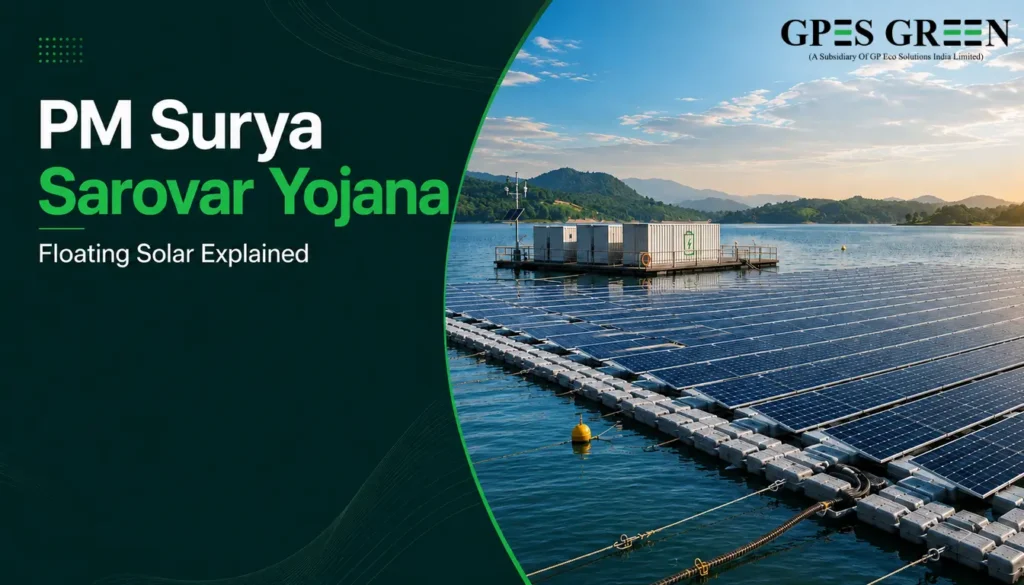
India’s solar sector is expanding beyond conventional ground-mounted and rooftop projects. The PM Surya Sarovar Yojana (PM-SSY) introduces a major push towards floating solar power plants, combined with energy storage.
The Union Cabinet approved the scheme on 31 July 2026, with a total outlay of ₹5,070 crore. It aims to support 5,000 MW of Floating Solar Photovoltaic (FSPV) projects, along with 10,000 MWh of energy storage built at the same sites.
But what makes floating solar important for India’s clean-energy transition, and what does it mean if you are planning a project?
What is floating solar?
Floating Solar Photovoltaic (FSPV) systems generate electricity using solar panels installed on engineered floating platforms, placed on suitable water bodies such as reservoirs and industrial ponds.
Instead of using large areas of land, the solar array sits on the water surface. It is held in place by anchor blocks resting on the reservoir bed, with cables running up to the platforms. Together these are called the anchoring and mooring system. It is designed around the site’s water depth, the wind, and how far the water level rises and falls through the year.
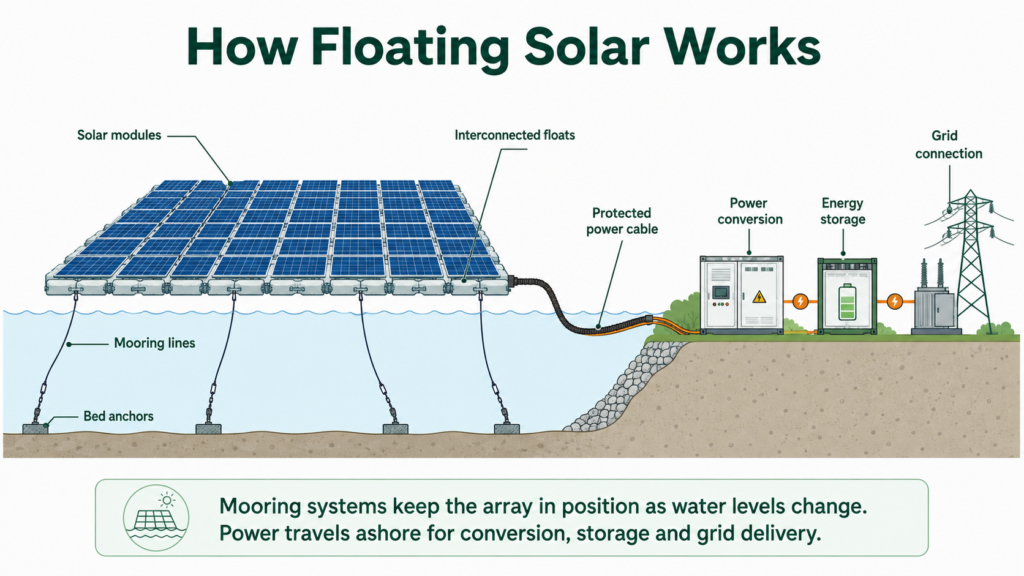
The electrical principle is the same as any conventional solar plant. Modules generate DC electricity, inverters convert it to AC, and the power is supplied to the grid or used alongside energy storage.
Why does floating solar matter for India?
One of the biggest challenges in developing utility-scale solar is finding suitable land.
Large projects need significant contiguous areasarea with clear ownership, access and transmission connectivity. Assembling that land, and clearing the title history behind it, often takes longer than the construction itself. Floating solar offers an additional route by using water surfaces that already exist and are already owned by a government body.
The scale of the opportunity is significant. A 2026 assessment by the National Institute of Solar Energy estimated India’s floating solar potential at approximately 102.18 GWp across reservoirs and other inland water bodies. That is more than 100,000 MW. Installed floating capacity today is only around 700 MW.
The PM-SSY target of 5 GW therefore represents an early step into a much larger opportunity.
What does PM-SSY actually offer?
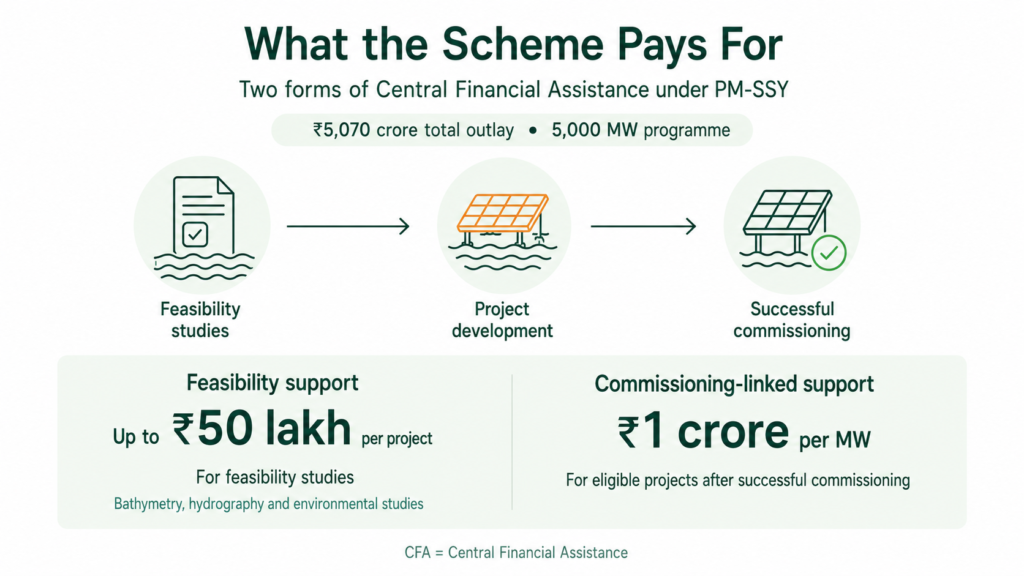
The scheme provides central financial assistance through two separate routes, and the difference between them matters.
Capacity-linked support: ₹1 crore per MW. This is paid after successful commissioning, meaning once the plant has been built, tested and brought into operation. It is not upfront construction funding, so developers finance the build themselves and carry the risk until the plant is running.
Feasibility support: up to ₹50 lakh per project. This covers the studies done before construction begins, including bathymetry (mapping the reservoir bed), hydrography (understanding how water levels behave through the year), and environmental assessments.
Funding site studies separately is a useful signal. It reflects the reality that floating projects are largely decided at the investigation stage, well before the first module is installed.
Projects are expected to be sanctioned between FY 2026-27 and FY 2030-31, with disbursement running up to FY 2032-33.
Why is storage part of the scheme?
Perhaps the most significant aspect of PM-SSY is that floating solar is being planned together with Energy Storage Systems (ESS).
The scheme targets 10,000 MWh of storage, with a minimum two-hour duration.
Why does this matter? Solar generation happens during daylight hours, while electricity demand often stays high into the evening. Storage allows surplus daytime generation to be captured and released when it is needed.
This is not a theoretical concern. Between April and June 2026, 8,133 GWh of solar generation in India was curtailed, meaning the grid could not absorb it and plants were instructed to reduce output. The figure was placed before the Rajya Sabha in July 2026, citing data from Grid Controller of India, the national grid operator. The reasons given were grid security and a gap between how fast solar projects are built and how fast transmission lines follow.
Pairing floating solar with storage makes projects more useful to the grid, and more predictable for the developer.
What are the benefits of floating solar?
· Reduced land dependence. Suitable water surfaces can be used instead of acquiring large land parcels.
· Better use of existing assets. Solar generation can sit alongside existing water resources, subject to site conditions.
· Possible performance gains. Water environments may help moderate module operating temperatures, although real gains depend on the site.
· Reduced evaporation. Shading part of the surface can limit water loss, which matters to the department that owns the reservoir.
· Integration with storage. Projects can combine generation and storage for greater flexibility.
· Large deployment potential. India’s reservoir network offers considerable scope for future capacity.
What does floating solar require on site?
Floating projects need specialised engineering, and a few things work differently from a land-based plant.
The site investigation replaces a soil report with a survey of the reservoir bed and its seasonal water-level range. Foundations are replaced by anchoring and mooring designed for that range. Cables run on or below water before coming ashore. Maintenance access is by boat or designed walkway, which has to be planned into the layout rather than added later.
Permissions also work differently. A floating project needs both a grid connection and permission to use a water surface controlled by an irrigation department, generation company, municipal body or industrial operator.
This makes early feasibility and project planning considerably more important than on a conventional plant.
Who can develop these projects?
Detailed eligibility rules have not yet been published by MNRE. Based on how the scheme is built, the organisations best placed to take part are those that already control suitable water:
· State generation companies and power utilities holding hydro reservoirs
· Central and state PSUs, particularly thermal stations with cooling reservoirs or ash ponds
· Independent power producers and project developers
· Irrigation departments, municipal bodies and industrial operators
India already has working examples. NTPC’s 100 MW floating plant at Ramagundam in Telangana spans roughly 500 acres of the station’s balancing reservoir and became fully operational in July 2022 at a reported cost of ₹423 crore. It was the country’s largest floating solar plant at the time.
At Omkareshwar on the Narmada reservoir in Madhya Pradesh, 278 MW has been commissioned against a planned 600 MW, developed through Rewa Ultra Mega Solar with NHDC, AMP Energy Green and SJVN.
In both cases, the developer appointed an EPC contractor to design and build the plant.
What does PM-SSY mean for India’s solar industry?
The scheme signals a shift in approach: from simply adding solar capacity to building more flexible, integrated renewable systems.
For project developers and solar EPC companies, it creates a new category of work in floating solar engineering, marine survey, anchoring design and grid connection infrastructure. For the storage sector, it puts a firm national number on demand for the first time.
The future: floating solar and storage together
India’s renewable challenge is increasingly about more than generating electricity. It is about where that electricity is generated, how well it integrates with the grid, and how effectively it can be stored and dispatched.
PM Surya Sarovar Yojana brings these together in one programme. At 5,000 MW of floating solar and 10,000 MWh of storage, it is large enough to build a supply chain around.
Detailed guidelines for the floating solar scheme are still awaited from MNRE. They will settle eligibility, allocation and tariff. Until then, anyone holding a suitable water body can still make progress. Find out who controls the surface, understand how far the water level moves through the year, and check what grid capacity is available nearby.
Conclusion
PM-SSY is the first national programme to treat floating solar and storage as one decision rather than two. For anyone holding a reservoir or an industrial pond, the question is no longer whether floating solar works. It is whether your particular site does, and that is answered by survey, not by opinion.
GPES Green Projects delivers floating solar EPC for utility, industrial and government clients, covering design, anchoring and mooring, environmental assessment, construction and grid connection. You can talk to our team about a reservoir or industrial water body you are assessing.
Frequently asked questions
What is PM Surya Sarovar Yojana?
PM-SSY is a central government scheme approved on 31 July 2026 to develop floating solar PV projects with co-located energy storage, with an outlay of ₹5,070 crore.
What is the target of PM-SSY?
The scheme targets 5,000 MW of floating solar capacity and 10,000 MWh of energy storage, with a minimum two-hour storage duration.
What financial support does the scheme provide?
₹1 crore per MW after successful commissioning, and up to ₹50 lakh per project for feasibility studies such as bathymetry, hydrography and environmental assessment.
What is India’s floating solar potential?
A 2026 NISE assessment estimated approximately 102.18 GWp across reservoirs and inland water bodies. Around 700 MW is currently installed.
Why combine floating solar with storage?
Storage allows daytime generation to be delivered in the evening, when demand is higher. It also reduces the risk of generation being curtailed when the grid cannot absorb midday output.
Is floating solar suitable for every reservoir?
No. Water depth, seasonal level variation, wind and wave conditions all matter, along with environmental factors and how the water is currently used. Distance to a grid connection is often the deciding factor.
