
Rooftop solar used to be a simple purchase: pick panels, pick an installer, and you were done. PM Surya Ghar: Muft Bijli Yojana has changed that. It now wraps a national subsidy, an online portal, approved vendors, and sign-off from the local distribution company, or DISCOM, around the same decision. Rooftop solar has become one of the most talked-about energy programmes in the country.
Most of that talk repeats the same handful of numbers, and some of it is already out of date. The subsidy is real, but it does not keep growing as the system gets larger, and the promise of 300 free units is widely misread.
There is also a more basic question hiding under all of it. Does this scheme apply to a commercial or industrial rooftop, or only to homes? This guide answers that, along with what the scheme offers, who qualifies, and how the money reaches you.
What is PM Surya Ghar Yojana?
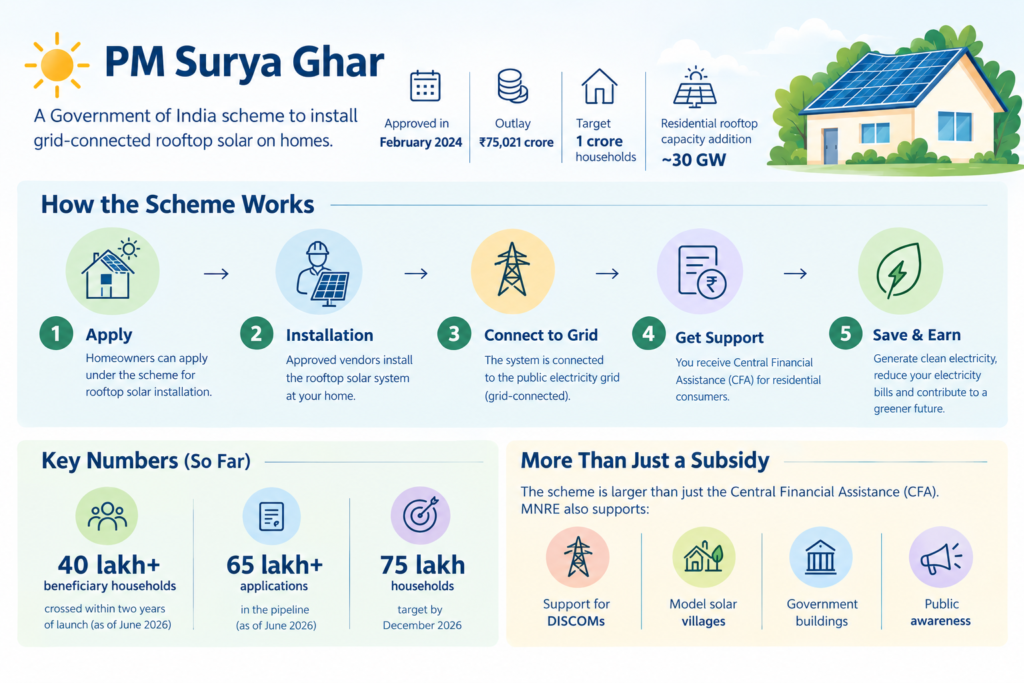
PM Surya Ghar is a Government of India scheme to install grid-connected rooftop solar on homes. Grid-connected means the system is wired into the public electricity grid instead of running on batteries alone. The government approved it in February 2024 with an outlay of ₹75,021 crore and a target of 1 crore households. Across those installations, it aims to add around 30 GW of rooftop capacity in the residential sector.
The part most people mean by the “PM Surya Ghar subsidy” is the Central Financial Assistance, or CFA, for residential consumers. The programme is larger than that one piece. MNRE, the Ministry of New and Renewable Energy, lists other parts under it too, including support for DISCOMs, model solar villages, government buildings and public awareness.
The rollout is already at scale. In June 2026, MNRE reported that the scheme had crossed 40 lakh beneficiary households within two years of launch, with more than 65 lakh applications in the pipeline. It has set a target of reaching 75 lakh households by December 2026.
How much is the subsidy, and where does it stop?
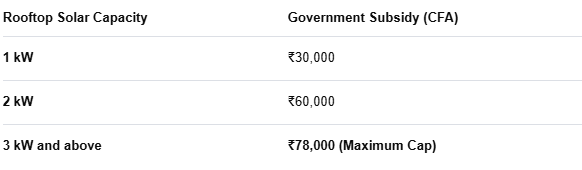
The residential CFA is tied to system size, but it is capped. It does not keep rising as the system grows. So an eligible 2 kW system can receive ₹60,000, and a 3 kW system can receive ₹78,000. A 4 kW, 5 kW, or 6 kW system still receives ₹78,000. The extra panels can generate more power, but they do not add to the central subsidy.
The subsidy is ₹30,000 per kW for the first 2 kW and ₹18,000 for the additional 1 kW. There is no additional Central Financial Assistance beyond 3 kW, as per the MNRE operational guidelines
Why does the subsidy stop climbing after 3 kW? The structure is deliberate. It supports the first few kilowatts a household needs, without paying more for every panel added on top.
This CFA belongs to the residential component. MNRE provides it to residential electricity consumers, and the National Portal is built around residential applicants. The PM Surya Ghar National Portal is structurally built to verify residential electricity consumer connections only. Commercial and industrial (C&I) clients do not qualify for any cash-back subsidies under this program
States can add to this. The guidelines let State and Union Territory governments top up the central CFA for residential consumers, processed through the National Portal. Final support can therefore differ from one state to another.
Who can apply, and how does the process work?
The CFA is meant for eligible residential electricity consumers installing grid-connected rooftop solar that meets the scheme guidelines. Those guidelines cover the connection, the installation, approved vendors, technical standards, and verification.
Equipment rules apply too. A project claiming CFA must follow the Domestic Content Requirement, or DCR, which means using solar cells and modules made in India. So the cheapest quote is not automatically the right one, because a scheme installation has to meet the rules, not only produce power.
The process runs through the National Rooftop Solar Portal:
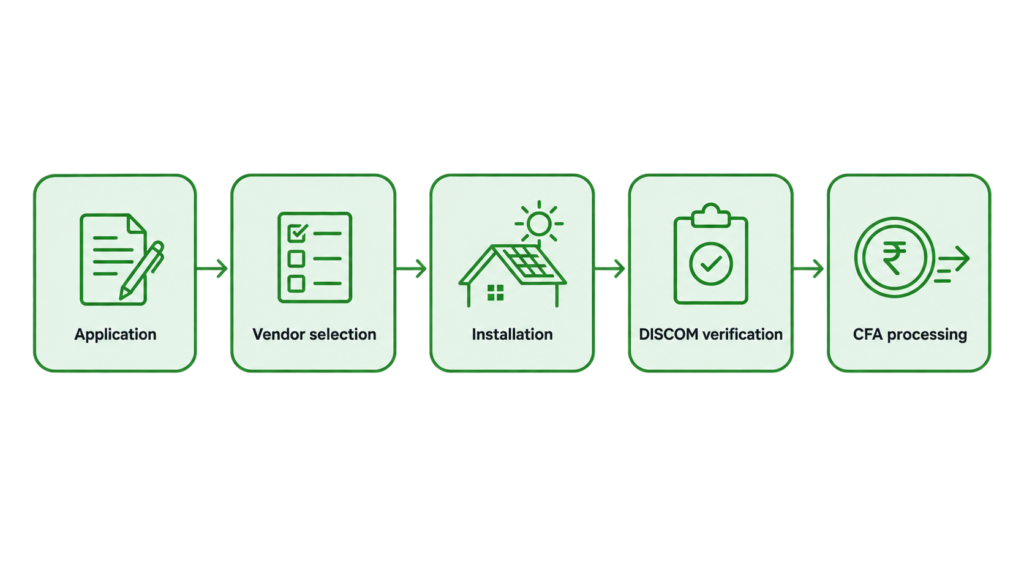
The applicant applies on the portal, picks an empanelled vendor, and gets the system installed. An empanelled vendor is one registered and approved under the scheme. The local DISCOM then inspects and verifies the installation. MNRE says the CFA is transferred directly to the consumer’s bank account after installation by an empanelled vendor and verification by the State DISCOM.
The DISCOM matters here because a grid-connected system feeds into the local distribution network. The distribution company handles the connection and the verification. PM Surya Ghar also carries a separate incentive for DISCOMs to expand rooftop adoption.
Does PM Surya Ghar really give 300 free units a month?
This is the most misread part of the scheme. “Muft Bijli” means free electricity, and it makes the programme easy to remember. It does not mean every household gets a fixed 300 units credited to its account each month.
The benefit is tied to what the rooftop system generates. The stated objective is up to 300 units of free electricity a month from a household’s own system. The actual benefit depends on the system size and on how much it generates and how much the household uses. Where a household produces more than it needs, it can earn from the surplus sent back to the grid.
By June 2026, the government reported more than 17 lakh households with zero electricity bills. So 300 units is best read as a target linked to generation, not a flat monthly allowance every household receives.
What has changed in the PM Surya Ghar rules since launch
The scheme has not stayed still since 2024. MNRE has issued clarifications and amendments as the rollout has progressed. These include a clarification in February 2025 and an amendment to the residential CFA guidelines in July 2025.
That matters for anyone researching it. An article written soon after launch may quote figures that were right then but no longer match the current rules. The reliable references are the latest MNRE notifications, the official rooftop solar portal, and the relevant DISCOM.
Does PM Surya Ghar cover commercial and industrial solar?
The residential CFA is not a subsidy for commercial or industrial solar. A factory, warehouse, or office has a different electricity profile from a home. Its solar project is usually larger, with its own technical requirements, financial calculations, and regulations.
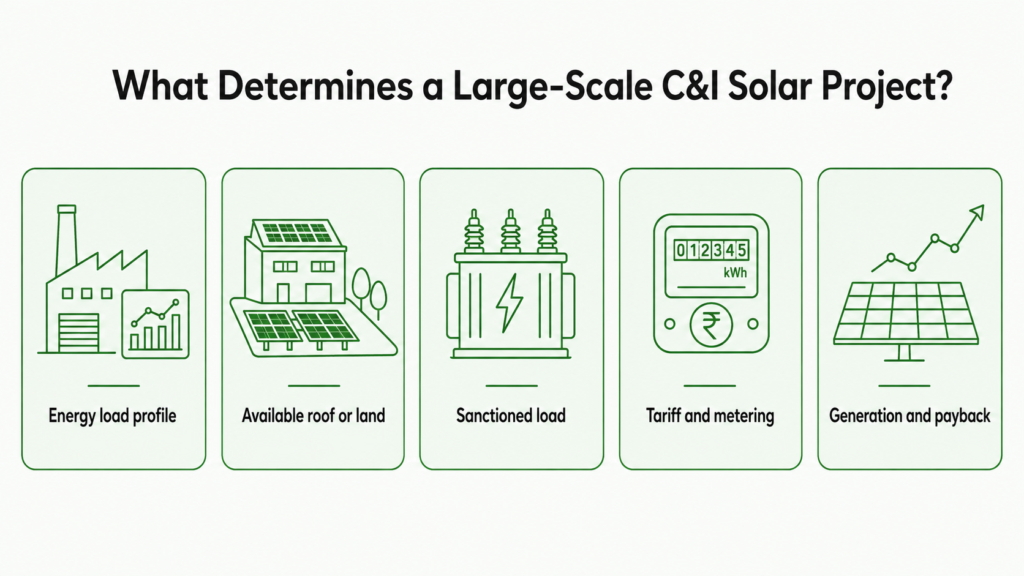
So for a business, the more useful question is about the project’s own numbers, not the PM Surya Ghar subsidy. How much power does the site use, how much roof or land is available, and what is the sanctioned load? How does daytime use line up with solar generation, what metering and grid connection apply, and what will the system generate over its working life?
Those questions sit in a different conversation from the residential subsidy. Mixing the two leads to wrong assumptions about cost and payback.
Where is rooftop solar heading?
The scheme’s biggest effect shows up beyond any single roof. It appears when millions of small systems start feeding the grid at the same time.
Reaching 1 crore households means vendors installing at scale, DISCOMs processing connections, manufacturers supplying compliant equipment, and the grid absorbing power generated close to where it is used. India’s solar story has usually been about large parks and utility-scale plants. Distributed rooftop is now becoming a serious part of the same picture.
So what should you do?
If you are a homeowner, the scheme is worth using, but plan around your roof and your usage, not the ₹78,000 headline. If you run a business, treat PM Surya Ghar as background. Your solar case rests on your own load, roof and tariff, and that is where the savings are actually decided.
GPES Green designs and builds large-scale solar for commercial, industrial and utility-scale sites, from project design through to commissioning. If your organisation is weighing a rooftop or ground-mounted project, talk to the team about assessing your site’s load, available area and generation potential.
Frequently asked questions
Can a bigger system get a bigger subsidy?
Not beyond a point. The central CFA is capped at ₹78,000, so capacity above 3 kW adds generation but not subsidy.
Does every household get 300 free units each month?
No, not as a fixed credit. The 300 units are a target linked to how much a rooftop system generates and how much the household uses. The real benefit varies by system and site.
Can a business claim the ₹78,000 subsidy?
The CFA is for residential consumers, so commercial and industrial projects do not qualify. Those projects fall under different rules and financial mechanisms.
How does the subsidy reach me?
After installation by an empanelled vendor and verification by the State DISCOM, MNRE transfers the CFA directly to your bank account through the National Portal.
Do I have to use particular equipment?
A project claiming CFA has to meet the Domestic Content Requirement, which means Indian-made cells and modules. The scheme guidelines also set the technical standards the system must follow.
Where do I check the current rules?
The latest MNRE notifications, the National Rooftop Solar Portal, and your DISCOM carry the current position. The scheme has been updated since launch, so older blogs may be out of date.
