
Most people meet the phrase solar EPC for the first time inside a proposal document, usually somewhere near the price. It sits there as though everyone already knows what it covers.
Behind those three letters is the whole question of who carries the risk. If a plant is built late, built smaller than promised, or refused a grid connection, somebody absorbs that cost. The contract decides who.
So what does a solar EPC contractor actually do between the first site visit and the day the plant starts feeding power?
What is solar EPC?
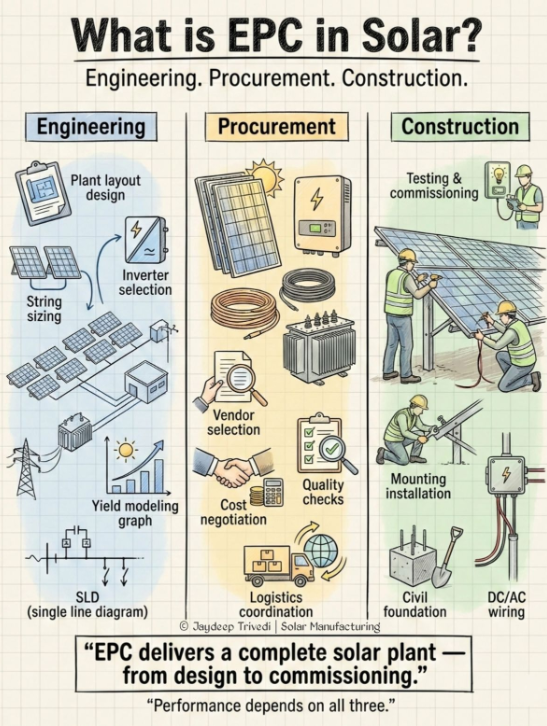
EPC stands for Engineering, Procurement and Construction. Under this model, one contractor takes responsibility for designing the plant, buying the equipment and building it, under a single contract.
The alternative is to hire a design consultant, buy equipment separately, and appoint a construction contractor. That works, but it leaves the buyer sitting between three parties whenever something does not match.
Solar EPC removes that position. If the design calls for one thing and the delivered equipment is another, resolving it is the contractor’s problem.
One point often missed: most EPC scopes end at commissioning, meaning once the plant has been tested and allowed to start generating. Operation and maintenance is usually a separate agreement, and it is worth confirming which one you are actually buying.
Why does project scale change how solar EPC works?
Most explanations of solar EPC describe one process and apply it to every project size. At MW scale, three things enter the picture that smaller work does not have to deal with, and each one can sit on the critical path.
Land. A ground-mounted project needs land that is available, correctly titled and reasonably free of shading and undulations. Land identification and the approvals attached to it often start before engineering does.
Grid connectivity. Generated power has to reach the network through evacuation infrastructure, meaning the cabling, switchgear and substation that carry output from the plant to the grid. This has to be approved by the DISCOM, the state distribution utility that owns the local network, and that approval runs on its own timetable.
The commercial structure. How the plant is owned changes who signs what. Under a Power Purchase Agreement (PPA), the buyer pays for electricity rather than for the plant. Under Build-Own-Operate-Transfer (BOOT), the developer builds and runs the asset before handing it over later. Open access and group captive arrangements let a business draw power from a plant sited elsewhere.
Why does this matter to you? Because it changes what “the project starts” means. On a large project, engineering, land work and grid applications often run in parallel, and the slowest of the three sets the date.
What are the stages, from design to commissioning?
The sequence below is the common shape. Real projects overlap stages, and the order can shift with site conditions.
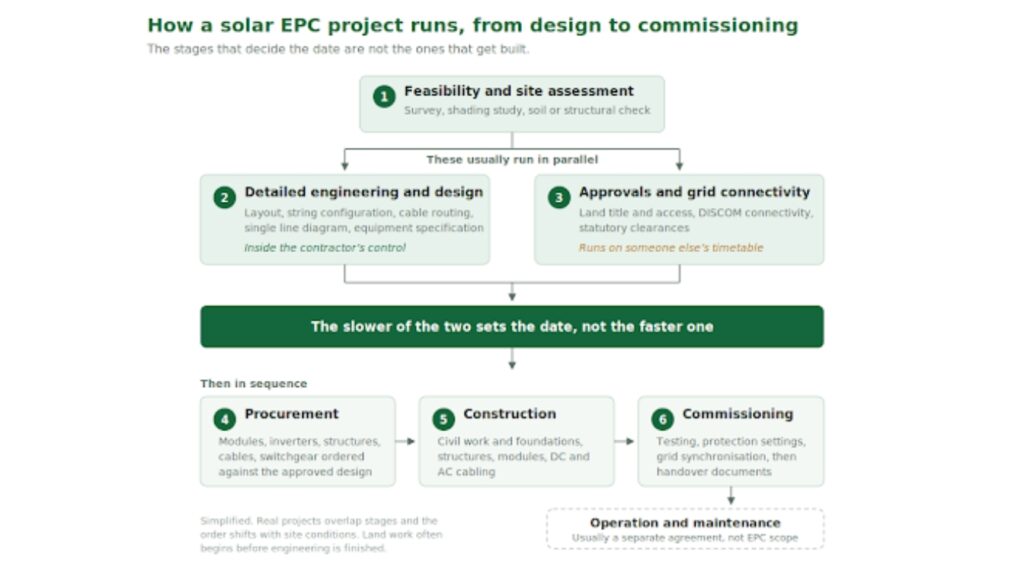
Flow diagram of a solar EPC project. Feasibility and site assessment come first. Detailed engineering and design then run in parallel with approvals and grid connectivity, and the slower of the two sets the date for procurement. Procurement, construction and commissioning follow in sequence. Operation and maintenance sits outside the flow as a usually separate agreement.
*Engineering is the stage a contractor controls. Approvals are the stage that decides the date.*
1. Feasibility and site assessment. Site survey, shading study, soil testing for ground-mounted plants or a structural check for rooftops, and an estimate of how much the plant will generate. Weak assumptions here are expensive later, because everything downstream is built on them.
2. Detailed engineering and design. Layout, module placement, string configuration, cable routing, and the single line diagram, which is the drawing that shows how power flows through the plant. This is also where the equipment specification is fixed.
3. Approvals and grid connectivity. Connectivity applications, DISCOM coordination and whatever statutory clearances the site attracts. Documentation gaps, not technical problems, are a frequent cause of delay at this stage.
4. Procurement. Ordering modules, inverters, mounting structures, cables and switchgear against the approved design. Lead times vary by item and by market conditions, so procurement decisions are often made well before anything is built.
5. Construction. Civil work and foundations, mounting structures, module installation, DC and AC cabling, and the electrical infrastructure that connects the plant onward. Safety management becomes a full workstream at this scale, not a checklist.
6. Testing, commissioning and handover. Insulation and continuity checks, inverter and transformer testing, protection settings, and synchronisation with the grid. Commissioning ends with the documents: as-built drawings, test reports, warranties and the monitoring setup.
Handover is the moment the asset becomes yours to run. What arrives with it, or fails to, determines how easy the next twenty years are.
How long does a solar EPC project take?
Honestly, there is no reliable single answer, and the numbers circulating online should be treated with care. Published timelines come mostly from company blogs quoting their own experience, and they are not comparable across sites.
What can be said is what moves the date. Approval timelines, equipment lead times, land readiness and monsoon access are the usual drivers, and only some are inside the contractor’s control.
A contractor who gives you a confident date without having seen the site is guessing. One who gives you a date tied to named dependencies is planning.
Is solar EPC the same as a turnkey contract?
Often, yes. The two terms are frequently used interchangeably, and in many Indian proposals they mean the same thing.
Where a distinction is drawn, it concerns pricing and risk. A lump-sum turnkey contract fixes a single price and places most cost and schedule risk on the contractor. Other EPC contracts are paid against milestones, with the buyer retaining more oversight and more exposure.
The safer approach is to ignore the label. Read the payment terms, the completion date, and what happens if that date is missed.
What should you check before signing?
Two-column comparison of solar EPC scope. Inside the contract: detailed engineering and design, equipment procurement, civil and electrical construction, testing and commissioning, handover documentation. Separate or varying: land acquisition and title, approvals and connectivity, evacuation infrastructure, operation and maintenance, performance guarantees.
*Two quotes that look far apart on price are often drawing this line in different places.*
- Scope boundaries. Where the contractor’s responsibility ends, and whether evacuation infrastructure, approvals and O&M sit inside or outside the price.
- Named equipment. Specific makes and model numbers in writing, not a quality tier. Confirm module compliance with whatever list your project is required to meet.
- The schedule and its consequences. A completion date, and what applies if it slips.
- Comparable references. Projects of similar size and type, and permission to speak to the people who commissioned them.
- What arrives at handover. As-built drawings, test reports, warranty documents and monitoring access, listed as deliverables in the contract.
What does this mean going ahead?
Grid capacity and approval throughput are becoming the constraint on Indian solar more than construction capability is. The engineering of a plant is well understood; getting it connected on schedule is the harder part.
For buyers, that shifts what an EPC contractor is worth. Familiarity with a specific utility’s process and realistic scheduling may matter more than a marginal difference in quoted price.
Conclusion
If you are evaluating proposals now, the fastest way to compare them is not on price. Put the scope boundaries, the named equipment and the completion terms of each one side by side, and the differences usually become obvious.
Then ask each contractor which dependency they think is most likely to move the date. The answers will tell you who has read the site.
GPES Green delivers turnkey solar EPC projects for commercial, industrial and utility clients. The scope covers engineering, procurement, construction and commissioning, with operation and maintenance and project management consultancy available as separate services.
Our work spans rooftop solar for C&I sites, ground-mounted projects for utility, open access and group captive, and the substations and switchyards that connect them.
If you have a site in mind, send the location and your current load details, and our team can talk you through what a project would involve.
Frequently asked questions
Does an EPC contract include maintenance?
Usually not by default. O&M is commonly a separate agreement, so confirm it instead of assuming it.
Who applies for the grid connection, the buyer or the contractor?
It depends on the contract and on the ownership structure. Under a PPA or BOOT arrangement, the developer typically handles it, but it should be written down either way.
Can an EPC contractor guarantee how much electricity the plant will generate?
Generation estimates are modelled from site data and are subject to weather and site conditions. Some contracts carry performance guarantees, so check whether yours does and what it actually promises.
What happens if equipment arrives late?
That depends entirely on the contract. Lump-sum turnkey agreements usually place that risk on the contractor, while other structures may not.
Is a lower quote a bad sign?
Not automatically, but it deserves a question. Ask what is different in the scope, the equipment or the schedule, because a genuine efficiency and an omission look identical on a summary sheet.
Can an existing plant be expanded later?
Often, though it depends on the sanctioned capacity, available space and the connection agreement, it is worth raising during design rather than after commissioning.
