
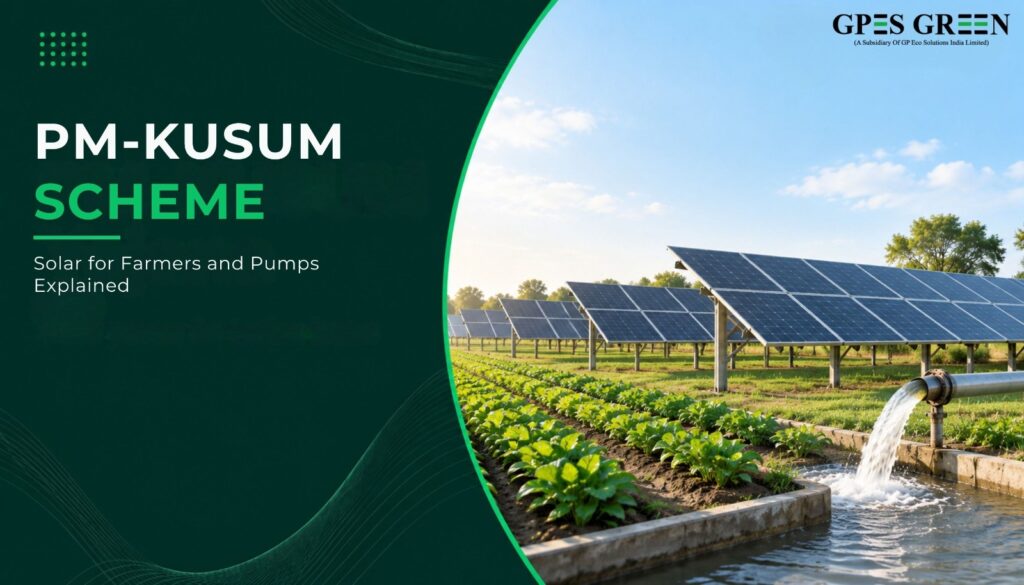
Two costs eat into an Indian farmer’s margin every season. One is diesel for the irrigation pump, and the other is the price of daytime grid power that is normally not available.
Idle land is a quiet cost too, and it earns nothing while it sits empty.
The Pradhan Mantri Kisan Urja Suraksha evam Utthaan Mahabhiyan, shortened to PM-KUSUM, was built to close all three gaps with solar power. The Ministry of New and Renewable Energy (MNRE) launched the scheme in March 2019. It now targets 34,800 MW of solar capacity, backed by a central outlay of ₹34,422 crore, and has already reached over 21.77 lakh farmers.
PM-KUSUM is made up of three different programmes, each serving a different purpose. The one built for a landowner or a project developer runs on completely different economics from the ones built around a single irrigation pump.
What are the Three Components of PM-KUSUM?
Every farmer, cooperative or developer looking at this scheme is really choosing between three separate programmes.
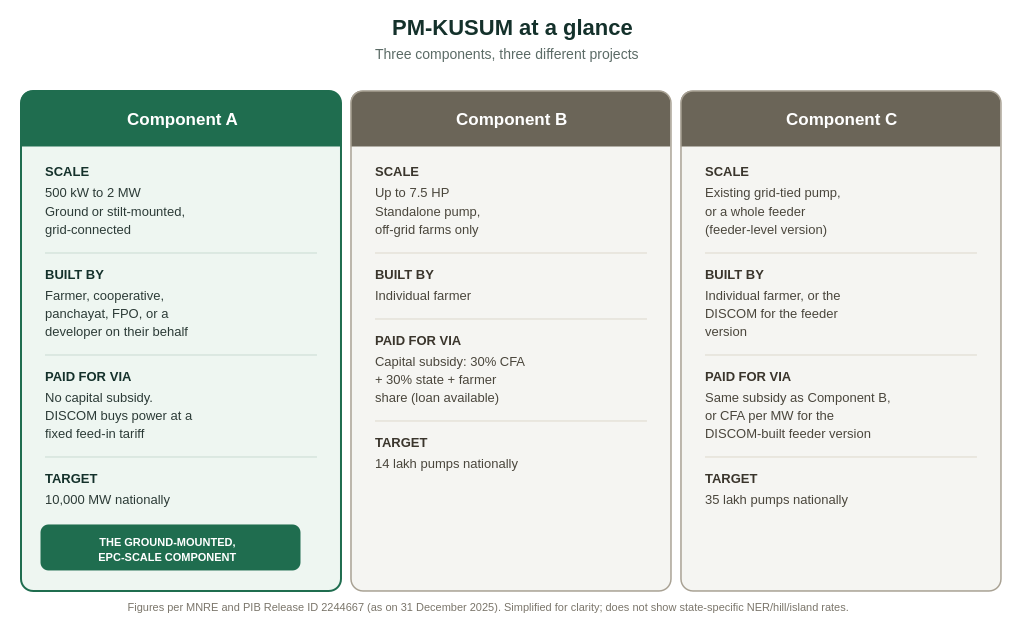
- Component A sets up decentralised solar power plants of 500 kW to 2 MW. These are built on the ground or on stilts and connected straight to the grid. Farmers, cooperatives, panchayats, Farmer Producer Organisations (FPOs), or a developer put these up, not MNRE.
- Component B funds standalone solar pumps of up to 7.5 HP, for farms with no grid connection at all.
- Component C solarises pumps that already run on grid power, usually one farm at a time, or less commonly, an entire irrigation feeder together.
Component A targets 10,000 MW on its own. Component B targets 14 lakh standalone pumps, and Component C targets 35 lakh grid-connected pumps, including the feeder version.
Component A is the only one of the three built and paid for like a conventional grid-connected solar project.
How does a Component A solar plant pay for itself?
Component A does not work like a subsidy scheme at all.
There is no CFA (Central Financial Assistance, the direct capital subsidy the other two components use) for a Component A plant. Instead, the DISCOM, the state-owned company that buys and distributes power, decides which of its substations has spare capacity. It then invites applications from what the scheme calls Renewable Power Generators, or RPGs. An RPG can be an individual farmer, a farmer group, a cooperative, a panchayat, an FPO or a Water User Association.
The RPG builds the plant and sells every unit to the DISCOM at a feed-in tariff set by the state electricity regulator in advance. The DISCOM, in turn, earns a Procurement Based Incentive for that purchase, at 40 paise per unit or ₹6.60 lakh per MW per year, whichever is lower. The incentive lasts five years from the date the plant starts supplying power.
Why does this matter? The return on a Component A project depends entirely on the tariff and the plant’s output. That is the same logic as any other DISCOM-facing solar plant, not subsidy arithmetic.
An RPG that cannot arrange the funding can bring in a developer, who then steps into the RPG role while the landowner earns lease rent.
How do Component B and Component C work?
Component B and Component C work more like a conventional subsidy.
For a standalone pump under Component B, MNRE pays 30% of the benchmark cost as CFA, or 50% in the North-East, Himalayan states, and island territories. The state government adds at least another 30%, and the farmer covers the rest, usually 10% upfront with the remainder financed as a loan.
Component C solarises a pump that is already on the grid. Solar capacity of up to twice the pump’s rating can be added. The farmer uses what the irrigation needs, and any surplus is sold to the DISCOM. The subsidy structure mirrors Component B.
A less common version of Component C, feeder-level solarisation, skips individual pumps entirely. The DISCOM builds one larger solar plant to power an entire agricultural feeder instead. This runs through CAPEX, where the DISCOM pays for and owns the plant, or RESCO, where a developer pays for and owns the plant and sells the power back. CFA of up to ₹1.05 crore per MW is available either way.
What changed with the PM-KUSUM deadline extension?
The scheme was due to close on 31 March 2026, and progress had not kept pace with the target. As of 31 December 2025, only 720.91 MW of the 10,000 MW Component A target had actually been commissioned. Banks were growing reluctant to lend against a deadline that was about to expire.
On 28 March 2026, MNRE issued an office memorandum extending the timeline. This covers only projects that already had a signed power purchase agreement or a notice to proceed by 31 December 2025. For those, financial closure on Component A and feeder-level Component C projects now has until 30 September 2026, and commissioning until 31 March 2027. Individual pump projects under Component B and Component C have until 30 September 2026 to commission.
A project with no power purchase agreement or notice to proceed by that cutoff sits outside the extension. Further relief will be decided case by case, and the remaining capacity looks set to carry into a successor programme rather than another extension.
Does the extension change the ALMM module rules?
No, and this is easy to miss. Separately from PM-KUSUM, MNRE has its own rule on modules. ALMM, the Approved List of Models and Manufacturers, decides which panel and cell brands qualify for government-linked projects. Every ALMM-covered project must use solar cells from an approved domestic list, called List-II, from 1 June 2026 onward.
In July 2026, MNRE extended a List-II exemption to 31 December 2026, but only for net-metering and open-access rooftop projects. Government-linked schemes, PM-KUSUM among them, were explicitly left out of that relief.
In practice, any Component A plant commissioning between now and the new March 2027 deadline already needs List-II compliant cells. Worth confirming with a module supplier before signing anything, not after.
Who builds a Component A plant, and who runs it afterwards?
An RPG rarely does the engineering itself. Land identification, the DISCOM application, plant design, procurement, and construction usually go to a ground-mounted solar EPC contractor. Sometimes that contractor works under a project management consultant appointed on the RPG’s behalf. The process follows the same broad stages as any other DISCOM-facing solar plant, from design through to commissioning.
A 25-year plant also needs 25 years of upkeep. Operation and maintenance covers inspection, cleaning and inverter checks. It is a real cost line to plan for from day one, not an afterthought once the plant is running.
What happens after March 2027, and what is PM-KUSUM 2.0?
The government has signalled a follow-on scheme, informally called PM-KUSUM 2.0, rather than another extension of the current one. Its Expenditure Finance Committee has cleared moving ahead, and the Union Budget for 2026-27 raised the scheme’s annual allocation by roughly 92%, to about ₹5,000 crore. Officials have spoken of a feeder-level push and an agrivoltaics component, growing crops underneath or between the panel rows. MNRE had not published formal guidelines, benchmark costs, or targets as this article was checked.
Anyone planning a fresh Component A project should treat the current scheme as effectively closed to new allocations. Confirm the live position with your State Implementing Agency or the MNRE portal before assuming anything about the successor scheme’s terms.
Conclusion
If a Component A site is on the table, two dates decide whether it still qualifies under the current scheme. The first is a power purchase agreement or notice to proceed dated on or before 31 December 2025. The second is financial closure by 30 September 2026. Without both, the project sits outside the current extension and effectively waits on PM-KUSUM 2.0’s terms.
GPES Green designs, engineers, procures and constructs ground-mounted solar plants at utility scale, and offers project management consultancy and O&M cover alongside the build.
Get in touch with your site location and DISCOM details, and we can talk through what a Component A project on your land would actually involve.
Frequently asked questions
Can a company that is not a farmer set up a Component A plant?
Yes, through the developer route. If the landholding farmers, cooperative, or panchayat cannot fund the plant, a developer can take on the Renewable Power Generator role, and the landowner earns lease rent.
Does Component A come with a capital subsidy like the pump components?
No, Component A earns money only through the tariff paid for the power it sells. The incentive scheme pays the DISCOM, not the plant owner.
What if my power purchase agreement was signed after 31 December 2025?
The 28 March 2026 extension does not cover it. MNRE has said relief beyond the new deadlines will be decided case by case, so check directly with your State Implementing Agency.
Is PM-KUSUM 2.0 open for applications yet?
Not yet. It has budget backing and internal government approval, but MNRE had not issued formal guidelines as of this article’s fact-check date.
Can Component A land also be farmed at the same time?
Under the current guidelines, Component A plants are ground- or stilt-mounted power projects, not agrivoltaic systems. Combined crop-and-solar use is one of the ideas floated for PM-KUSUM 2.0, not a feature of the scheme today.
How is this different from PM Surya Sarovar Yojana?
Both are DISCOM-facing decentralised solar schemes with feed-in tariffs. Component A sits on farmland, while PM Surya Sarovar Yojana sits on water bodies such as reservoirs and irrigation tanks. PM Surya Sarovar Yojana also carries a storage requirement that Component A does not.
