

A bigger industrial solar plant doesn’t always mean a smaller electricity bill.
That’s the part many factory owners find out only after the system is running. Your roof may have room for hundreds of kilowatts, but your actual savings depend on when you use power, which charges solar can cut, and how much of your consumption the plant can cover.
And in 2026, new rules around captive solar, cell sourcing, and transmission charges add another layer to the decision.
This blog breaks down how much industrial solar can actually cut from your factory’s electricity costs, what your roof can cover, and which 2026 changes could affect your project.
What your factory is actually paying for
An industrial electricity bill in India is not one price multiplied by one number. It has three broad parts, and they behave differently.
Energy charges: What you pay per unit of electricity consumed, measured in kWh. This is the part that falls when you generate your own power.
Demand charges: What you pay for the capacity kept available to you, billed against your contract demand in kVA. Contract demand is the maximum draw you have agreed with the distribution company. Most tariff schedules bill you on your recorded peak or a fixed percentage of that contracted figure, whichever is higher. You pay this whether the machines run or not.
Pass-throughs and time-based charges: Fuel and power purchase adjustment, electricity duty, and in many states a premium on units drawn during declared peak hours.
An on-site solar plant attacks the first of those three. It does very little to the second on its own. Your peak draw is set by the moment every compressor and furnace runs together, and that moment may fall at 9 pm. Pass-throughs shrink in proportion to the units you stop importing, but they do not disappear.
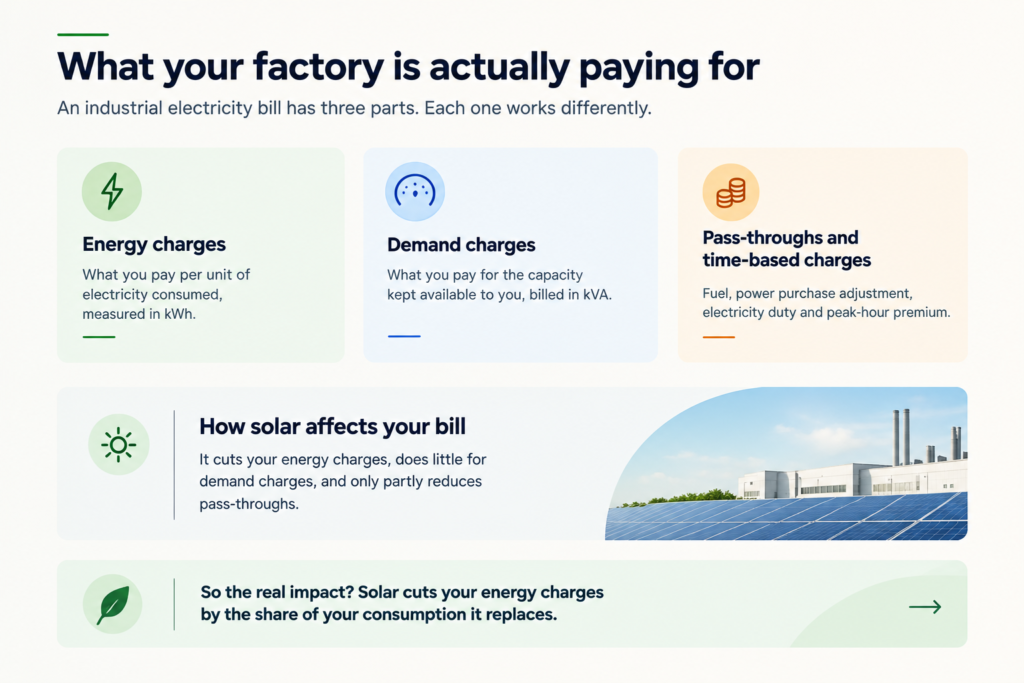
So the honest version of the claim is that solar cuts your energy charges by roughly the share of your consumption it replaces. Whether that becomes the headline percentage depends on how much of your bill is demand charges, and that share varies by state and by consumer category.
How much of the bill the roof can actually reach
Three limits decide what share of your consumption an on-site system can cover, and none of them is the sales brochure.
Usable roof area: Planning figures of roughly 8 to 10 square metres per kWp are common, but “usable” carries the weight. Skylights, ventilators, ducting, walkways, shading from adjacent sheds, and the load-bearing capacity of the sheeting all come out of the total first.
The regulatory ceiling: Most state commissions cap the capacity you can connect under net metering at or below your sanctioned load or contract demand. The reference and rules differ by state. Telangana’s rooftop guidelines, for instance, require open access capacity and rooftop capacity together to stay within the contracted maximum demand. The two routes compete for the same headroom. Gujarat’s regulations set a 1 MW ceiling on net-metered systems and tie non-residential capacity to sanctioned load. Check your own state’s regulation before designing to a number.
When you use power: Solar generates on a daytime curve. A single-shift plant matches it well. A three-shift plant with continuous process load draws most of its units when there is no sun, and the roof cannot follow it there.
Work it out on your own figures instead of on a percentage. Take twelve months of units consumed from your bills, then take the capacity your usable roof and your sanctioned load will actually permit.
Multiply that capacity by the annual generation your site can support. An engineer confirms that figure with a shadow analysis and a structural survey, not with a rule of thumb. The result, divided by your annual consumption, is your real coverage.
For a single-shift unit with a large shed roof, that number is often high. For a continuous-process plant on a constrained roof, it can be a fraction. Either way, the share of consumption covered is the figure to ask your solar EPC partner for.
The routes that cover what the roof cannot
Once the roof is full, the remaining consumption has to come from somewhere else. Indian regulation gives a factory three practical routes, and choosing between them is mostly a question of surcharges.
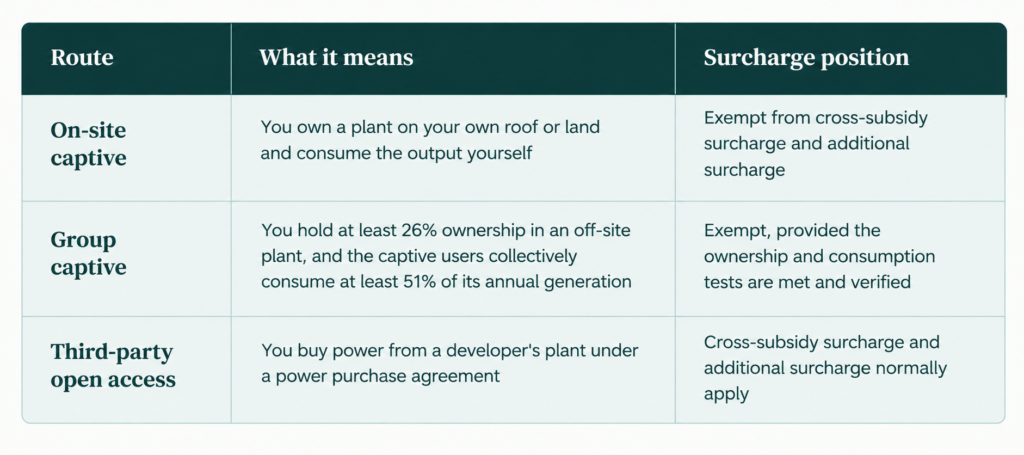
The threshold for green open access fell from 1 MW to 100 kW of contracted demand or sanctioned load, and captive consumers face no minimum. Applications are to be decided in 15 days, failing which they are treated as approved.
Cross-subsidy surcharge is what a distribution company levies to recover the subsidy it loses when a paying industrial consumer leaves its supply. The additional surcharge covers fixed costs it has already committed on your behalf. Together, they can decide whether an off-site tariff is attractive or ordinary, which is why the captive routes draw the interest they do.
Three things changed in 2026, and they set your timeline
Most writing on industrial solar describes the framework that applied two years ago. Three changes in 2026 affect what a factory should do now.
The captive rules were rewritten in March
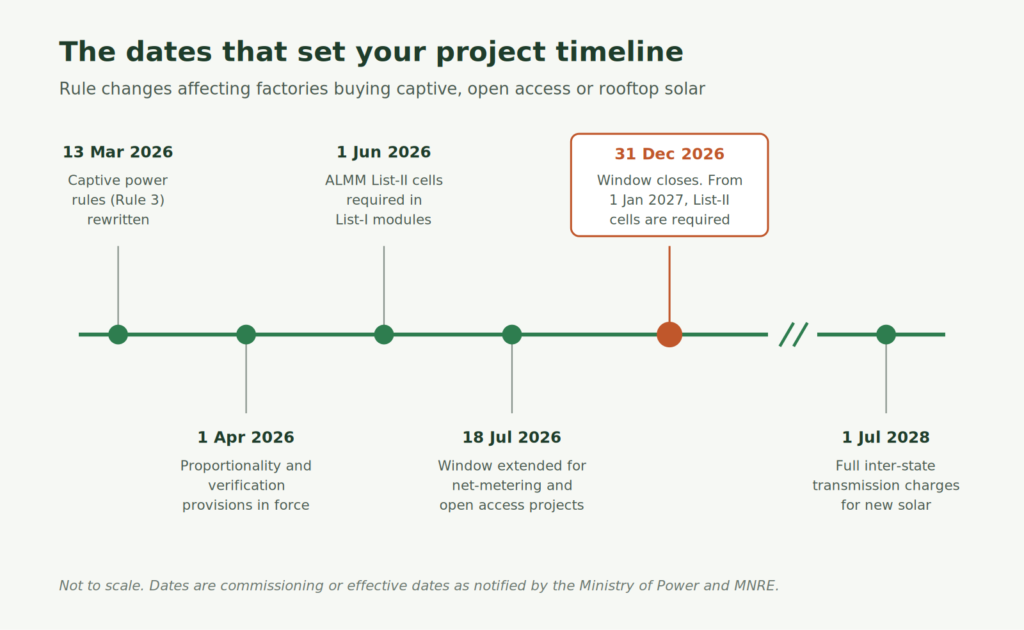
On 13 March 2026, the Ministry of Power notified the Electricity (Amendment) Rules, 2026 through G.S.R. 186(E), replacing Rule 3 of the Electricity Rules, 2005 in full. Rule 3 decides whether a plant qualifies as captive, and therefore whether you pay the surcharges.
Captive users must hold at least 26% ownership and must consume at least 51% of annual generation.
A captive user that is a company now includes its subsidiaries, its holding company, and that holding company’s other subsidiaries. All of them count as a single captive user. Ownership counts indirect holdings, so a group can reach the 26% threshold across entities instead of forcing one company to hold it alone. Special purpose vehicles are treated as an association of persons.
Consumption is handled more flexibly than before. A user may draw according to operational need, and anything beyond its proportionate entitlement stops counting as that user’s captive consumption while still counting towards the collective 51%. A user holding 26% or more in its own right escapes the proportionality test altogether.
Electricity delivered through an energy storage system sitting between the plant and the user now expressly counts as captive consumption. Verification moves to designated state nodal agencies, with the National Load Despatch Centre handling inter-state cases. Some of these provisions took effect on 1 April 2026.
For a factory, the practical effect is that group captive has become easier to structure and harder to lose by accident. If you evaluated it before 2026 and walked away because the proportionality arithmetic looked fragile, the reason you walked away has changed.
The cell sourcing deadline moved to 31 December
Since 1 June 2026, modules on the Approved List of Models and Manufacturers List-I have had to use cells from ALMM List-II, which lists approved domestic cell manufacturers. Net-metering and open access projects were given a narrower path. On 18 July 2026, the Ministry of New and Renewable Energy extended its exemption window to 31 December 2026. It confirmed there would be no blanket extension beyond that date.
Projects in those two categories commissioned on or before 31 December 2026 may use existing cell supply. Projects commissioned from 1 January 2027 must use ALMM List-II cells.
That is a commissioning-date question, not a procurement question, and commissioning dates slip on approvals more often than on equipment. If your project sits close to that line, two things matter more than the module price on your quotation. One is the date written into your contract. The other is the realism of your DISCOM approval schedule.
Transmission charges for out-of-state power are climbing back
If your off-site plant sits in another state, inter-state transmission charges apply on a rising trajectory set by commissioning date. Solar commissioned up to 30 June 2025 kept a full waiver. After that, charges phase in by commissioning window, reaching the full amount for projects commissioned on or after 1 July 2028.
Sourcing from a sun-rich state some distance away used to be close to free on transmission. It is no longer, and the landed cost of an out-of-state tariff needs the applicable charge built in.
What to check before you sign
Five things, in the order they usually go wrong.
- Ask for the share of consumption covered, not the percentage off the bill. Make the EPC show the calculation against your twelve months of units.
- Ask what happens to demand charges. If the answer is nothing, that is a fair answer. If storage or load management is proposed to reduce them, ask for the peak data it is based on.
- Get the commissioning date into the contract, with the ALMM cut-off named and responsibility for delay allocated.
- Confirm the route and its surcharges. A tariff quoted without cross-subsidy and additional surcharge, where they apply, is not the tariff you will pay.
- Take the tax benefit to your CA, not your EPC. Solar power generating systems attract 40% depreciation on the written-down value basis under the Income Tax Rules. Plants put to use for less than 180 days in the year get half of that in year one. Companies that have opted into the concessional regime under Section 115BAA cannot claim additional depreciation on top. The 60% figure quoted in a lot of solar marketing does not apply to every buyer.
What to expect next
State commissions are still issuing procedures under the amended captive rules, so verification practice will settle over the coming year, and early group captive structures may need adjusting.
Several states are also revising rooftop regulations to bring storage into the picture for consumers installing beyond their contract demand. If your plant is large and your peak sits outside daylight hours, that is where the economics are moving.
Where to begin
Start with your bills, not with your roof. Twelve months of units, your contract demand in kVA, and the split between energy and demand charges will tell you more than any site photograph.
GPES Green designs and delivers turnkey solar projects for commercial, industrial, and utility-scale clients.
Send us those twelve months of bills and your sanctioned load. Our team can walk you through what your roof can carry and which route covers the rest.
Frequently asked questions
How much can a factory realistically save with solar?
It depends on what share of your consumption the system covers, and on how much of your bill is energy charges as against demand charges. A single-shift plant with a large roof can cover a high share of its units. A three-shift plant usually needs an off-site route as well.
Does solar reduce demand charges?
Not by itself, in most cases. Demand charges follow your peak draw against contract demand, and that peak may fall outside generating hours. Reducing them takes storage, load shifting, or a revision of contract demand, each assessed against your own load data.
What is the minimum size for green open access?
The Green Energy Open Access Rules, 2022 set the threshold at 100 kW of contracted demand or sanctioned load. This may be aggregated across multiple connections in the same electricity division. Captive consumers have no minimum. State implementation varies, so check your state’s position.
What is group captive, in plain terms?
An off-site plant in which the consuming industries hold at least 26% of the ownership and collectively consume at least 51% of what it generates each year. Meeting both tests exempts that consumption from cross-subsidy and additional surcharge. The governing rules were rewritten on 13 March 2026.
Why does the commissioning date matter so much right now?
Because net-metering and open access projects commissioned on or before 31 December 2026 fall inside the current ALMM List-II exemption window, and projects commissioned after it do not. The date decides which cells your modules must use.
Can we combine rooftop solar with open access?
Often yes, but not always to the full extent of both. Some states count rooftop capacity and open access capacity together against the same contracted demand, so the two share one ceiling. This is a state-level check to make early, before either is sized.
