

A factory can buy renewable power without owning a solar plant. It can also own a share of one. Those two choices may look similar on paper, but the charges, ownership rules, and savings can be very different.
In March 2026, the rules are about to change, particularly regarding how group captive projects are tested for 51% consumption.
What does this imply for the industry if you do want to build a captive solar power plant?
This blog introduces the concept of captive solar, the difference between captive, group captive, and open access, the implications of the 2026 rule change, and what industrial buyers should look for before signing on a project.
What a captive solar power plant actually is
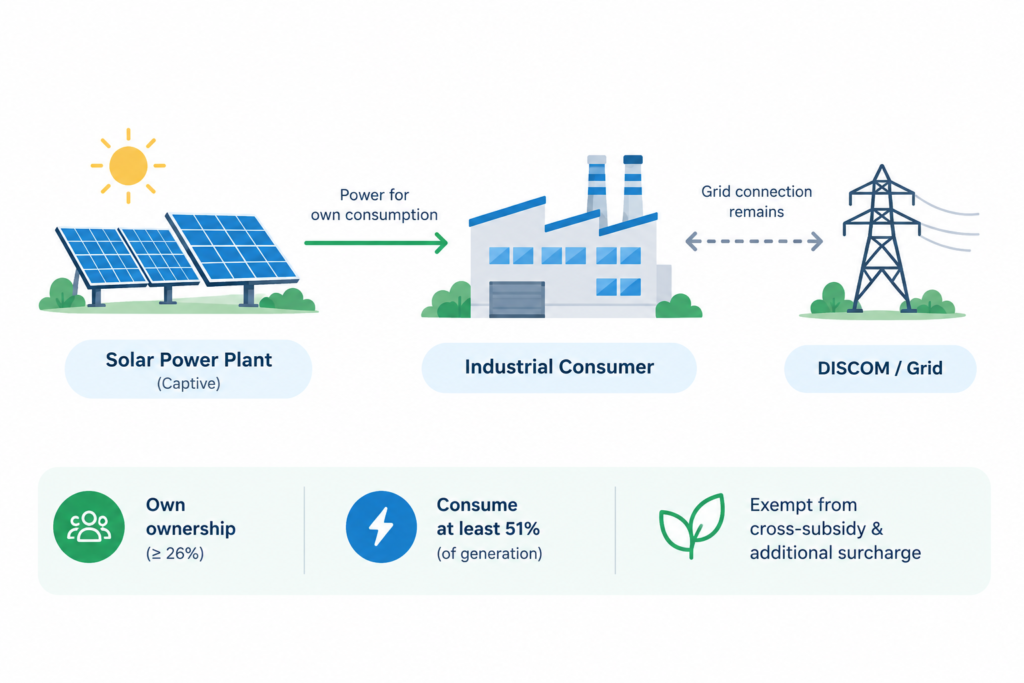
A captive solar power plant is a solar project built for one industrial consumer, or a group of consumers, who use the electricity generated by the plant for their own operations. Instead of simply buying renewable power from a third-party generator, the consumer has an ownership interest in the generating plant.
For an industrial business, that plant could be installed on its own premises, on nearby land, or as part of a larger shared project. The right structure depends on the company’s electricity demand, available space, investment capacity, and whether it wants to own the plant alone or alongside other consumers.
Captive is a defined legal status, not a marketing term. Section 9 of the Electricity Act, 2003 allows any person to set up a generating plant mainly for their own use. Rule 3 of the Electricity Rules, 2005 sets the conditions a plant must meet to be recognised as captive. Captive users must own at least 26% of the plant and consume at least 51% of what it generates, checked on a financial-year basis.
This is also where an experienced EPC partner such as GPES Green becomes relevant, particularly when the project involves site selection, plant sizing, evacuation, metering, and commissioning.
If both conditions are met, the power you consume captively is exempt from the cross-subsidy surcharge and the additional surcharge. An ordinary open-access buyer pays both on top of the energy charge. Miss either condition, and the exemption disappears for the year.
Why industrial buyers choose captive Solar
The appeal is straightforward once the ownership condition is out of the way. A captive plant fixes your generation cost for its working life, typically 25 years for solar. A manufacturer stops negotiating against DISCOM tariff revisions every year, and starts planning against a cost that barely moves.
The ownership stake also gives the consumer a real say in how the project is sited and engineered. That is worth more than a fixed tariff set by someone else’s return requirements.
Companies reporting to a board or to lenders on sustainability get a cleaner story too. The power is generated on an asset they part-own, not bought in as green power dressed up with a certificate.
None of this removes the DISCOM connection. A captive plant rarely covers all of a factory’s load, particularly one running multiple shifts. The grid connection stays in place for the rest of the demand, and for night-time supply. What changes is how much of the bill is exposed to tariff movement, instead of being fixed by contract.
Captive, group captive, or open access
A standalone captive plant suits a business with enough rooftop or adjoining land to host a plant sized to its own load. Here, one consumer holds the required ownership and consumes the required share directly, where a rooftop system fits better than a full ground-mounted plant.
For businesses without the space or the appetite to hold that much equity alone, group captive is the more common route. Several consumers pool into a special purpose vehicle that owns and operates a shared plant, each holding a slice of equity and drawing power roughly in proportion.
Open access without captive ownership is the third route: buying renewable power from a third-party generator, with no equity stake in the plant. It is simpler to set up, but it does not carry the captive exemption from cross-subsidy and additional surcharge. It also only opens to consumers with a contracted demand or sanctioned load of 100 kW or more, under the Green Energy Open Access Rules, 2022. Captive consumers face no such load floor: even a small facility can qualify through a proportionate share of a shared plant.
The rule that just changed: how your consumption is checked now
Most guides to captive solar stop at “26% ownership, 51% consumption,” as though that were the whole test. For a single-owner plant, it is. Few factories can host a full-sized plant alone, so most industrial buyers actually reach captive solar through a group captive structure. How that 51% gets measured is where the disputes used to start, and it is also the part the government rewrote on 13 March 2026.
Under it, every captive user in a group had to independently consume about 1.96% of the plant’s generation for every 1% of ownership held. A variation of 10% either way was allowed.
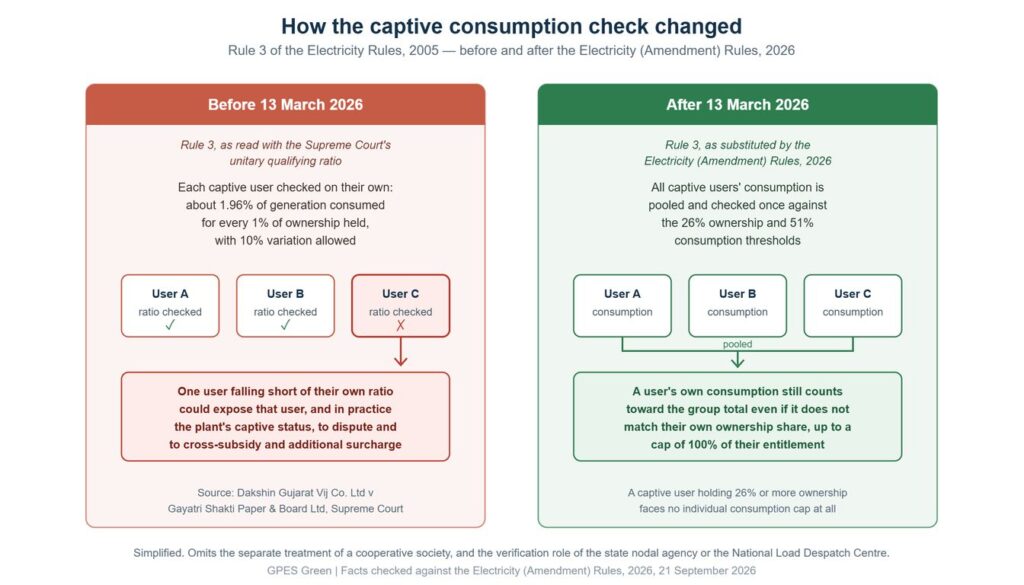
The Electricity (Amendment) Rules, 2026, notified on 13 March 2026, replaced that individual test with a collective one. Under the new Rule 3, the consumption of all captive users in a group is pooled. It is checked once against the 26% and 51% thresholds, instead of member by member.
An individual user’s actual consumption now counts toward the group total, even where it runs ahead of or behind their own ownership share. This holds up to a cap of 100% of their proportionate entitlement; consumption beyond that draws the surcharges as ordinary, non-captive supply. A captive user holding 26% ownership or more faces no individual cap at all, which matters most for the anchor investor in a group captive SPV.
The amendment also widened who counts as a captive user. Ownership can now be held through a subsidiary, a holding company, or a fellow subsidiary of that holding company. Electricity consumed through an energy storage system placed between the plant and the user now counts as captive consumption too. That matters for anyone pairing a captive plant with batteries to firm up supply.
Verification runs through a two-track process. A state nodal agency verifies status where the plant and its users sit in the same state. The National Load Despatch Centre does so instead, under a Central Government-approved procedure, where they do not. A grievance redressal committee has also been added, and surcharges are held back pending verification as long as the captive user files a declaration.
What changed is how a group of consumers actually clears the 51% bar. That is worth re-checking with your EPC partner and legal advisor if a project was structured around the old individual test.
What to check before you sign on
- Ownership structure: Confirm in writing what percentage you, and any other captive users, will hold in the plant or its SPV. Check whether that stake is direct or routed through a subsidiary or holding company; this decides your consumption entitlement.
- Consumption entitlement: Ask your developer or EPC partner to show, in writing, your proportionate entitlement under the new collective test, and whether your projected load clears it.
- Evacuation and metering: A captive plant still needs an approved evacuation line to the grid, with metering that supports whichever verification route applies. This is core EPC scope.
- Verification paperwork: Confirm which nodal agency or process will verify your project, and keep the declaration current, so surcharges stay deferred, not applied, while verification is pending.
- Tax treatment: GST on a solar EPC contract is typically charged as a composite supply, split 70:30 between goods and services, working out to an effective rate of roughly 8.9%. Ask your EPC partner to show this split on the quotation, instead of a single blended GST line.
What is still unsettled
The 2026 Amendment answers the ownership and consumption questions that generated most of the past litigation, but it leaves the operating detail to the bodies it names. The National Load Despatch Centre has yet to publish its detailed procedure for verifying inter-state captive projects. State nodal agencies are at different stages of setting out their own.
Until those procedures are out, a project already under construction or at the tendering stage should get a short written note from its EPC partner and legal advisor. It should explain how the project’s own structure is expected to be verified.
Where to start
A captive solar power plant puts the decision back in the buyer’s hands: what gets built, where, and on what terms, instead of a tariff set by someone else’s investment case.
GPES Green works with industrial and commercial clients on the engineering, procurement and construction side of captive projects. Its scope runs from site assessment and evacuation planning through to commissioning and ongoing operations and maintenance.
Talk to GPES Green about what a captive plant sized to your load would look like.
Frequently asked questions
Is a captive solar power plant only for very large factories?
No, Captive status carries no minimum size of its own; the 26% ownership and 51% consumption conditions apply regardless of the plant’s capacity. Group captive structures let smaller consumers hold a proportionate share of a larger, shared plant, instead of building a full-sized one alone.
What is the difference between captive and open access solar?
In captive solar, the consumer holds equity in the generating plant and consumes a defined share of its output. This qualifies for exemption from cross-subsidy and additional surcharge. In open access without captive ownership, the consumer buys power from a third-party generator with no equity stake. They remain liable for those surcharges and need a contracted demand of at least 100 kW.
Did the 26% ownership and 51% consumption figures change in 2026?
No, both figures are unchanged. What changed is how a group’s consumption is measured against the 51% figure: from an individual, per-user test to a pooled, collective one.
Can a captive solar plant be combined with battery storage?
Yes, the 2026 Amendment recognises consumption drawn through an energy storage system, placed between the plant and the captive user, as captive consumption. This removes an ambiguity that solar-plus-storage projects previously had to work around.
Who verifies whether a project actually qualifies as captive?
A state nodal agency, where the plant and its captive users sit in the same state. The National Load Despatch Centre does this instead, under a Central Government-approved procedure, where they sit in different states.
Does a captive plant remove the factory’s grid connection?
No, a captive plant typically covers part of a facility’s load, and the grid connection remains in place to cover the rest, including night-time and low-generation periods.
