
A power cut at a commercial facility can stop production, spoil refrigerated goods, interrupt equipment, and force the facility to switch to a diesel generator.
That’s where hybrid solar gets interesting. Solar handles the daytime load, the battery steps in when the grid drops, and the grid stays available when the other two can’t cover the demand. But the engineering, sizing, metering, and safety rules behind it aren’t quite as simple.
And there’s a new deadline to keep in mind. CEA’s battery safety rules take effect in April 2027, which matters if you’re signing a hybrid solar project today.
This guide explains how hybrid solar systems work, where the battery fits into the power flow, what the new CEA rules require, and what to check before you approve a commercial system.
What a hybrid solar system actually is
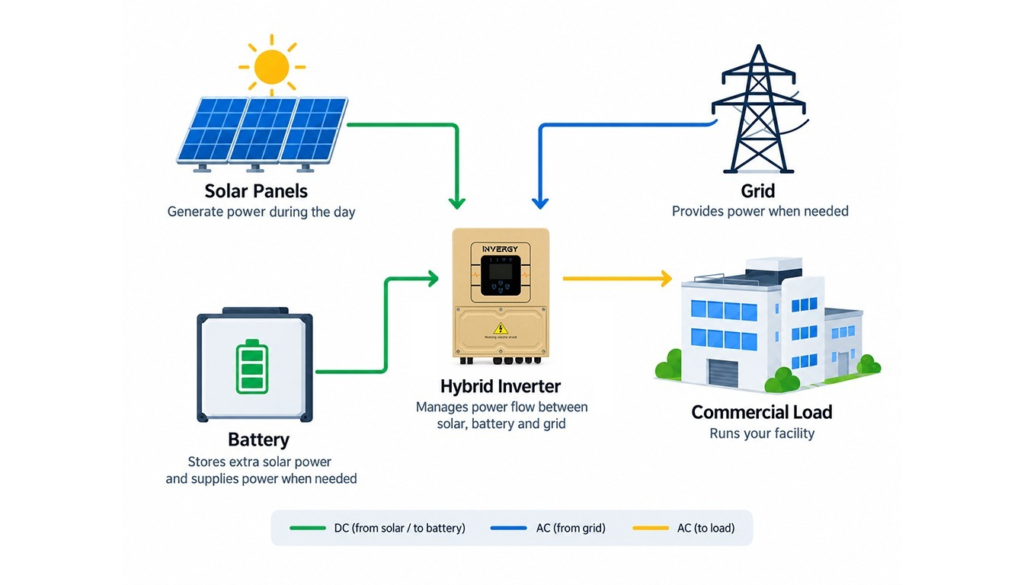
In a commercial context, a hybrid solar system means three things working together: solar panels, a battery, and a live connection to the grid. A hybrid inverter coordinates all three, deciding where the power goes moment to moment. Solar covers the load while the sun is up. The battery covers gaps when it is not, and the grid is the backstop for whatever neither can supply.
This is a different use of the word “hybrid” from the one in government renewable energy policy. The Ministry of New and Renewable Energy’s wind-solar hybrid framework describes utility-scale plants that combine wind and solar generation on one site to smooth grid variability. The two terms get used interchangeably online, which is an easy way to end up reading about the wrong scheme.
Why use hybrid solar instead of diesel backup?
Diesel backup is the default for most Indian commercial and industrial sites, and it is not cheap. Industry estimates put the generation cost of a diesel set at ₹16 to ₹40 per unit. Fuel alone accounts for 75 to 80 percent of that over the set’s lifetime. Every hour spent on diesel because the grid tripped is an hour of production paid for at several times the grid rate.
A hybrid system does not remove outages. It changes what happens during one. A short trip, the kind that used to mean firing up the generator, gets absorbed by the battery instead. The blended cost of stored solar and grid power is reliably lower than diesel, and the generator becomes the answer to a longer outage instead of every outage.
This is also where hybrid earns its place over solar without storage. A grid-tied solar system with no battery shuts down the moment the grid does. That is an anti-islanding requirement, not a design flaw, and it means the panels sit idle during the exact hours a facility feels an outage most.
How the system decides where power goes
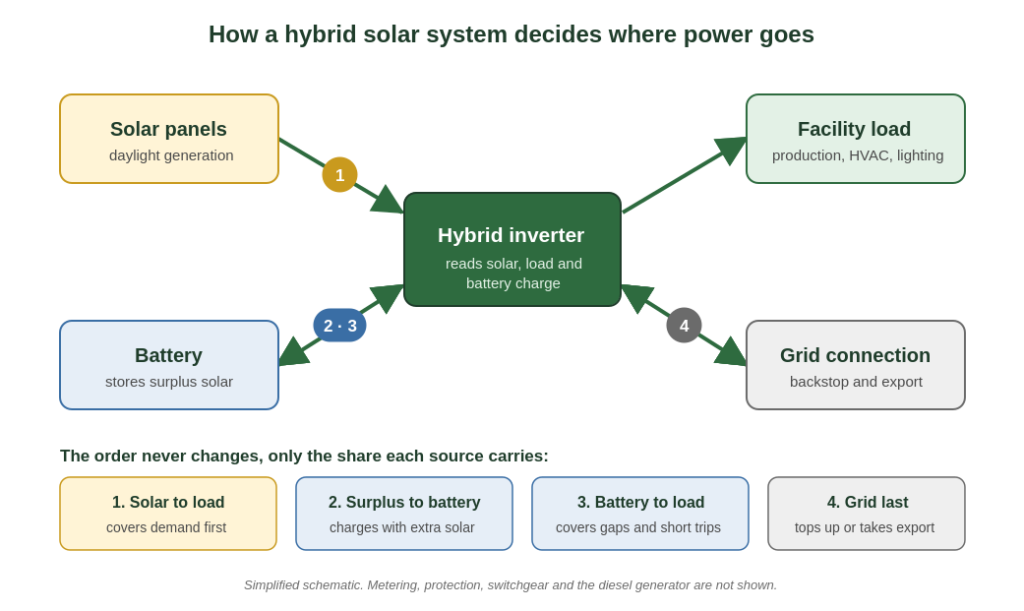
The hybrid inverter does the actual decision-making, not the battery. It reads the solar output, the load, and the battery’s state of charge. It then routes power in a fixed order: solar to the load first, surplus to the battery second, battery to the load third, and the grid last. The grid either tops up a shortfall or absorbs an export.
The inverter manages the power flow, but the battery’s capacity determines how long it can support the load during an outage. That is why sizing should start with the site’s outage history and critical power needs, not a generic backup-duration estimate. Storage sizing sits within GPES Green’s energy storage capabilities, alongside solar EPC delivery.
Where the connection fits into billing
At MW scale, most commercial and industrial hybrid systems are not on net metering. India’s central rules reserve net metering, where surplus solar simply offsets the bill, for small systems only. Larger connections mostly move to gross metering or net billing once a threshold is crossed.
That threshold is state- and DISCOM (local electricity distribution company) specific, and it has shifted in several states recently. Confirm it against the current supply code, not a figure from an older article.
For a facility on an open access or captive arrangement, the hybrid system sits within that structure rather than changing it. What changes is how the exported or banked units get valued, which affects the payback calculation more than the engineering.
Our guide to how solar EPC projects move from design to commissioning covers the wider process this fits inside.
The rule that changes what a compliant system looks like
If you are signing a hybrid solar project today, there is one future requirement worth discussing before the design is finalised. In March 2026, the Central Electricity Authority notified the Central Electricity Authority (Measures relating to Safety and Electric Supply) Amendment Regulations, 2026. The new battery safety requirements will take effect from 1 April 2027.
The requirements apply to battery installations connected above 650 V. Systems at or below 650 V are not covered by this chapter and will follow separate standards when the CEA publishes them. For larger commercial and industrial projects, especially those connected at higher voltage, this threshold can be important.
For systems covered by the new rules, the battery and the equipment that converts its power must be able to handle two faults at the same time without creating an unsafe situation. The system should either continue operating safely or shut down safely. A third-party fire safety audit will also be required within three months of the rules taking effect, with the report submitted to the Electrical Inspector.
These requirements affect more than the battery itself. If the system will be operating after April 2027, ask the EPC to consider these requirements while finalising the battery enclosure, protection equipment, inverter and fire-safety arrangements.
The CEA is also expected to publish the detailed technical standards within the same three-month period. Until then, the EPC should clearly explain which requirements are already included in the design and which details will be confirmed once those standards are published.
What to check before signing off on a design
- Outage history, not a rule of thumb: Ask for the site’s actual grid-outage record over the last one to two years. A battery sized against real data costs differently from one sized against a guess.
- The 650 V threshold on your own system: If the connection is HT or the battery sits above 650 V, Chapter XA applies from April 2027. Confirm this before the design is finalised.
- Two-fault tolerance in the power conversion system spec, not just the battery datasheet: The requirement covers the system as a whole, and a battery management system without matching inverter-side protection does not meet it alone.
- Current metering status with the DISCOM: Confirm the applicable net metering, gross metering, or net billing rules for your state and connection category.
- Any subsidy claim already built into a quote: The battery storage viability gap funding scheme in the news funds standalone, grid-scale projects that sell storage capacity to DISCOMs through tenders. It does not extend to a captive system behind a factory meter, so a quote assuming otherwise starts from the wrong number. The storage requirement under PM Surya Sarovar Yojana is similarly tied to utility-scale floating solar plants, not captive sites.
What to watch next
The CEA is due to publish its list of applicable technical standards for battery storage within three months of the regulations taking effect. That list will settle details including exactly which IEC and Indian Standards apply to which component. Systems at or below 650 V are also waiting on their own standard, since Chapter XA does not cover them. Until both are published, the safer choice for anything approaching MW scale is building to the requirements already known instead of retrofitting later.
Where this leaves a buyer
A hybrid solar system can help a commercial facility maintain power during grid interruptions while reducing its reliance on diesel. The key is to size the battery around the site’s actual needs and account for the applicable safety requirements from the design stage.
GPES Green’s EPC scope covers hybrid and energy storage systems alongside rooftop, ground-mounted, and floating solar, delivered for industries, utilities, and communities.
Send over the site’s outage history and connection details, and the team can walk through what a compliant hybrid design would look like for that load.
Frequently asked questions
Is a hybrid solar system the same as an off-grid system?
No, an off-grid system has no grid connection and has to be sized for the worst case on its own. A hybrid system keeps the grid as a backstop, which usually means a smaller, cheaper battery for the same reliability.
Does a hybrid system keep running during a total grid outage?
Yes, provided the inverter and protection are designed for it. The system has to detect the outage and isolate from the grid safely before it can keep serving the facility load from solar and battery alone.
How long should the battery back up the facility for?
Long enough to cover the outages that actually happen on that site, not a generic figure. Two hours suits a short, frequent-trip profile; a facility with longer outages needs a different sizing calculation.
Will the new CEA rules apply to an existing hybrid system?
Chapter XA’s fire safety audit requirement applies to installations above 650 V once the regulations are in force, which reads as covering existing systems too. Confirm this with your EPC partner as the CEA’s supporting standards are published.
Does GPES Green’s hybrid design include energy storage sizing?
GPES Green’s EPC scope covers hybrid and energy storage systems alongside rooftop, ground-mounted, and floating solar. Confirm sizing and specification details for a specific site directly with the project team.
