

Most businesses arrive at solar through the electricity bill. A factory, a warehouse, or a hospital on a commercial tariff pays for every unit it draws, and that per-unit charge has been climbing for years.
A rooftop plant works on exactly that part of the bill. It generates during working hours, feeds the building directly, and the meter records less consumption from the grid.
That is the easy part. The harder part is that a rooftop plant is a capital decision. What it can deliver is settled by a few site facts most buyers never think to check.
So what should a business look at before committing to one?
What counts as commercial rooftop solar?
Commercial rooftop solar covers plants on factory sheds, warehouse roofs, malls, hospitals, hotels, campuses and government buildings. Capacities run from a few tens of kilowatts to several MW on a large industrial site.
Size is measured in kWp, meaning rated output under standard test conditions. A 500 kWp plant will not produce 500 kW at every moment, and no site should be sized as though it will.
At this scale, the engineering, the approvals and the commercial structure all differ from small installations. Generic solar advice misleads these buyers for that reason.
Why does your roof not decide the size of your plant?
Roof area is one of three limits, and the smallest governs.
• Usable roof area. Not total roof area. Walkways, skylights, ducting, exhaust units, and the setbacks that keep the array out of shadow all come off first.
• Sanctioned load or contract demand. Sanctioned load is the maximum your connection is approved to draw, in kW. High-tension consumers work to a contract demand instead, stated in kVA. Most state regulations cap plant capacity against one of these.
• The distribution transformer feeding your site. Utilities limit how much solar a single transformer can host. CEEW’s review of state regulations found this ceiling set anywhere from 15 per cent to 100 per cent of transformer capacity.
A buyer who sizes only on roof area meets the other two at the approval stage, after the design has been priced.
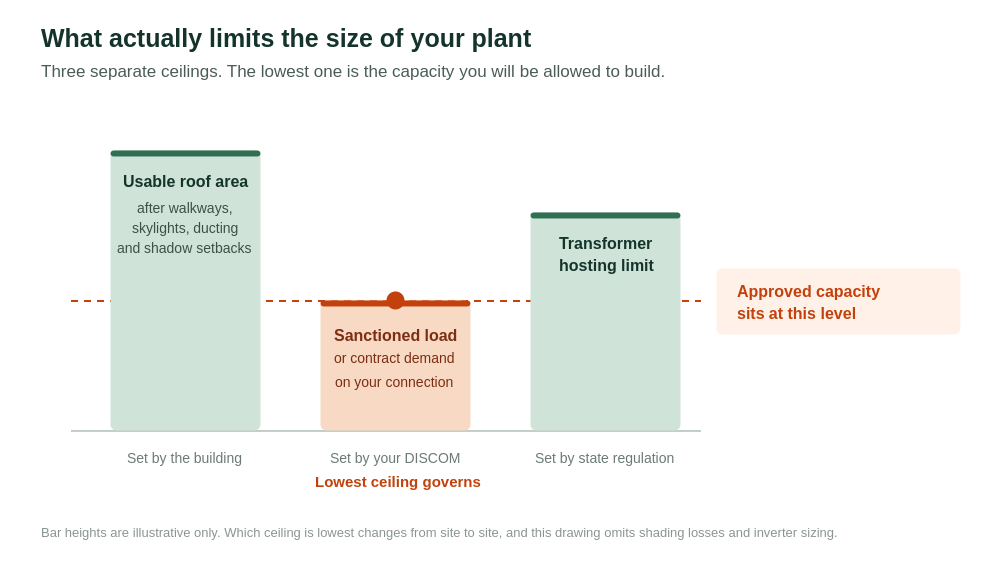
The three limits are set by different parties, which is why they tend to get checked at different times.
Can the roof actually carry it?
The array adds weight, but wind governs the design. Panels at a tilt catch wind from underneath, and the resulting uplift pulls at every fixing. IS 875 (Part 3): 2015 is the Indian standard for wind loads on buildings, and a structural assessment works from it.
On a metal shed, the questions are purlin spacing, sheet condition, and how the clamps transfer load into the frame. On an RCC roof, they move to slab capacity, waterproofing, and whether the structure is penetrated or ballasted.
Roof life matters as much as roof strength. A plant runs for 25 years, so a roof with eight years left needs resheeting before the array goes up.
Several DISCOMs now ask for a signed structural stability certificate before releasing the net meter. Discovering that after the plant is built is an avoidable way to lose a month.
How does the electricity get counted?
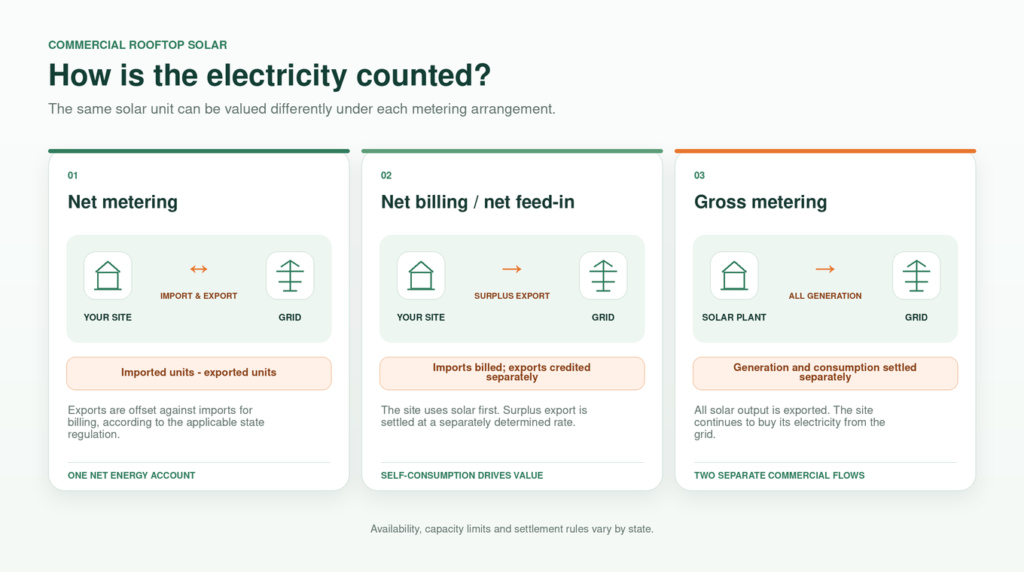
Three arrangements are in common use, and they value an exported unit differently.
• Net metering. Exported units are credited against imported ones, so an exported unit is worth roughly what an imported one costs.
• Net billing or net feed-in. Exported units are bought at a rate the State Commission sets, usually well below the retail tariff.
• Gross metering. All generation goes to the utility at an agreed rate, and the site keeps buying its power as before.
The Electricity (Rights of Consumers) Amendment Rules, 2021 set a fallback. Where a state’s own regulations are silent, the Commission may allow net metering for loads up to 500 kW or up to the sanctioned load, whichever is lower. Above that, net billing or net feed-in applies.
That 500 kW line is where commercial economics changes shape. Past it, a plant earns most of its value from power consumed on site, which makes the building’s load profile the central design input.
State regulations govern in practice, and they differ, so the number that applies to your site comes from your State Commission.
What is changing in the rules right now?
Two things are moving, and both affect decisions being taken this quarter.
The ALMM window closes on 31 December 2026. ALMM is the Approved List of Models and Manufacturers, a register kept by the Ministry of New and Renewable Energy. List-I covers solar modules. List-II covers the cells inside those modules, and a module made in India does not automatically contain List-II cells.
Since 1 June 2026, net-metering and open-access projects have had to use List-II cells. On 18 July 2026, the Ministry opened a limited window: projects in these two categories commissioned on or before 31 December 2026 stay exempt. From 1 January 2027, List-II applies.
Why does this matter to a buyer? Because the commissioning date decides which rule applies, not the date the order was placed. A project that slips past December changes its bill of quantities.
A draft central rule would price exported power. The Ministry of Power issued the draft Electricity (Rights of Consumers) Amendment Rules, 2026 on 12 March 2026. Comments closed on 11 April 2026, and effect was proposed from 1 October 2026. As at the date of this article, it has not been notified as final, so everything below is a proposal.
The draft would let State Commissions levy a net metering charge on systems above 5 kW, which in practice means every commercial plant. It would also let them require energy storage on renewable installations above 500 kW. Time-of-day tariffs, where the price of a unit changes with the hour, would become mandatory for commercial and industrial consumers above 10 kW demand from 1 April 2027.
None of this is settled. What a buyer can do now is leave physical and electrical room for storage to be added later. The powers would sit with State Commissions, so the state regulation is the document to watch.
Who owns the plant, and who pays for it?
• CAPEX. You fund the plant and own it. You keep all the savings and the tax benefits, and you carry the performance risk.
• OPEX, also called RESCO. A renewable energy service company funds, owns, and maintains the plant on your roof. You sign a long-term agreement and buy units at an agreed rate, with little or nothing upfront.
A third route is to own the plant but appoint a project management consultant to run delivery. The choice turns on cost of capital, balance sheet treatment and how long you expect to occupy the building. Roof lease terms, buyout clauses and the maintenance obligation deserve closer reading than the headline tariff, because they are expensive to change later.
What does this mean going ahead?
India’s grid is being asked to absorb more daytime solar than it comfortably can, and the rules are moving to price that rather than to ban it. Exporting surplus power is becoming less valuable, and storage is drifting from optional towards occasionally required.
A plant built today purely to maximise export may be the wrong plant in three years. Designing around what the site consumes, and leaving room to add storage as a hybrid system, is the more durable position.
Three questions worth putting to any supplier in writing:
• Which ALMM list the quoted modules sit on, and which commissioning date the quote assumes
• What the structural assessment concludes, signed by whoever is accountable for it
• What the plant does commercially if export is restricted or repriced
Frequently asked questions
How large a rooftop plant can a business install?
The smallest of three limits governs: usable roof area, the sanctioned load or contract demand on your connection, and the hosting limit on your distribution transformer. Roof area alone is not a safe basis for sizing.
Does a commercial rooftop plant need approval beyond the DISCOM?
Usually yes. Many states route commercial and industrial plants through the electrical inspectorate before energisation, and building or fire clearances can apply. Thresholds vary by state.
Is net metering still available to commercial consumers?
In most states, yes, subject to the state’s own regulations, with 500 kW a common dividing line. A draft central rule would allow State Commissions to charge for it, but that rule has not been notified.
What happens to a project commissioned after 31 December 2026?
It falls outside the current exemption window and must use modules built with ALMM List-II cells. Confirm this against the commissioning schedule before placing an order.
Can a rooftop plant run the site at night?
No. Solar generates in daylight only, so evening operation needs grid supply or a storage system sized for it.
Is a rooftop always the right answer?
No. If consumption is large against the usable roof area, or the structure cannot carry the array needed, aground-mounted plant may suit the site better. Open access is the other route.
Conclusion
Three documents settle most of what a rooftop plant can be, and all three exist before any supplier is involved. Twelve months of electricity bills, the sanctioned load or contract demand from your connection agreement, and a structural assessment of the roof. Gather those first and every quotation becomes easier to compare.
GPES Green delivers rooftop solar for commercial and industrial sites, with each project beginning from a site assessment and a financial analysis before any design is fixed. Delivered work is listed on our projects page.
If you are weighing a plant for your facility, get in touch with our team; we offer a free site assessment covering what your roof, your connection, and your consumption pattern will support.
